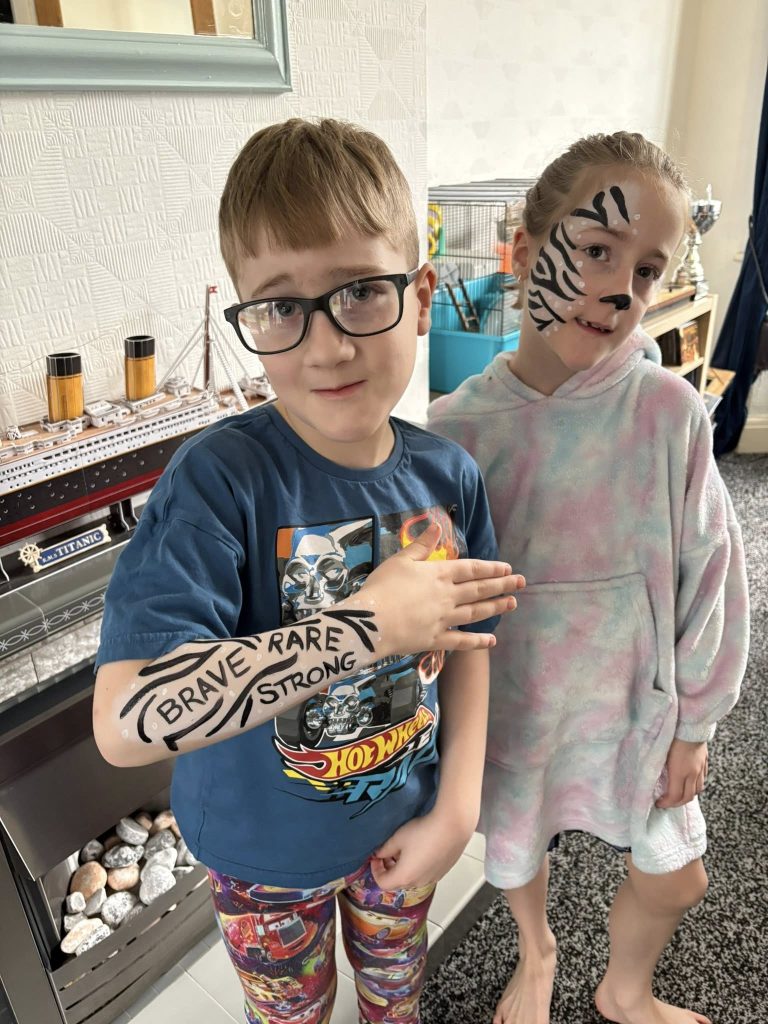
I’m going to start off my story, as not only an account about our experience with Isaac, but as an appeal to the medical community: please consider neurological causes when children — or even adults — present with unusual symptoms, such as unexplained paralysis, limping, incoordination or confusion.
We need our medical communities at smaller local hospitals — not only here in the UK, but worldwide — to be better trained to recognize neurological symptoms.
It took our local hospital 13 hospital visits over the course of two months before anything neurological was considered for Isaac — despite symptoms that, in hindsight, were clearly neurological. Even after they diagnosed him with encephalitis, no MRI was performed.
We are not expecting doctors to instantly recognize such a rare condition like MOGAD, but please do not cast aside unusual symptoms — especially when a child, such as ours, may not be able to communicate clearly due to a neurodivergence, like autism.
It took Isaac collapsing completely before we saw a neurologist, and even after that, we were still being told he was faking a limp (and other symptoms), and it seems this was because he was treated differently due to his neurodiverse condition.
Please listen to parents.
Please look at the whole child.
Please don’t dismiss symptoms.
Because earlier action can change everything.
Isaac’s story with MOGAD
Our journey with Isaac’s poor health began in the last week of Year One at school when he was six.
He initially started limping on one leg, yet randomly swapped to the other foot the next day. Then came hips and knee issues. Soon after, he became unwell – fevers, fatigue, loss of appetite, and not himself. Our local GP couldn’t find the cause, so we were sent to the hospital. Still, no answers.
Over the six-week school holidays, things worsened. The hospital kept telling us it’s viral arthritis. Normal blood results seemed to outweigh the clear changes we were seeing and reporting on. No one ever considered anything neurological; no one ever did any standard neuro observations.
Within a few weeks his twin sister, Aria — who Isaac shared a room with — screamed for me in the middle of the night. We ran in. Isaac was unresponsive in his bed; laid in his vomit; he was really hot, sweating. Aria, or any child, should never have to witness that.
We called for an ambulance, but a two hour wait was too long, so bundled him in a car and rushed him to the local hospital. The hospital immediately treated him for encephalitis, because he was unresponsive — breathing, but not alert or reacting to anything, just groaning.
We were in hospital for four days whilst he was treated. They did a spinal tap and discharged him with some medication.
There was still no MRI
As he’d improved and was now responsive, running around and communicating again — without knowing any better — I was happy enough for him to be discharged.
And then, before long, we were back at the hospital. He developed sudden confusion, spoke nonsense, his fever returned.I told the doctors that I thought it was neurological. But they just kept saying to me, ‘he’s just recovering, he’s just recovering.’ Eventually, a doctor agreed to do an MRI — but this was not booked for another four weeks in the future.
Yet again, we go home. Shortly after, though, he declined sharply. He was confused, dragged his leg again, and was away with the fairies completely. I took him back to the hospital.
The junior doctor who eventually came round that night said that Isaac was ‘faking it because of his autism’ and ‘you’re not going to get your MRI any quicker by bringing him into A&E.’ I broke down. The nurse came running in and asked: ‘What’s going on?’ Blubbering, I just said someone has told us he’s faking it.
It was late, so we were sent home with a promise a senior doctor would be in contact, but I really wasn’t happy. The next morning, a consultant called urgently and told us to immediately come in. She was the first to say, ‘there’s clearly something going on neurologically’ — the first to truly hear us.
When Things Turned Around
After the MRI, things changed: We were transferred to a children’s hospital, and by this point, he couldn’t walk anymore, sit up, or use one arm. He had lost bladder control and was bedbound.
Scans showed a large brain lesion. We were given a list of possible diagnoses, including cancer. All I wanted to ask them was, ‘Is my son going to survive?’ I know it’s brutal, but it was what I needed to know at the time.
Cancer was ruled out, and soon after, we received the MOGAD results, and he started on the high dosage steroids, which have worked to-date.
Today, Isaac is recovering – but life looks very different.
He now lives with permanent changes to his brain. Daily fatigue and neurological difficulties — especially with memory and communication, limb pain, mobility challenges, and lasting damage to his vision, via damage to the left optic nerve.
He is back at school, but on shortened hours and we are having to send him to a specialist school — plus I had to quit work in the meantime for his care. Overall, he is still the cheeky chappy he was before, but he just has a lot more going on, a lot more needs now than what he ever did before.
We were later told that even a few days earlier treatment could have prevented the severity of his condition and long-term damage. We can’t help but think things could have been different, better.
Twin Sister's Charity Run
As I mentioned, Isaac has a loving twin sister Aria. At just eight years old, she’s going to take on the Great Manchester Run this year to raise funds for the MOG Project. To find out more and to donate, please visit the fundraiser page.
I cried reading what your son Isaac and all of you, his family, had to suffer. My prayer is that your darling son will recover much better than currently expected.
My son was stricken too at age 6 – more than 20 years ago – before MOGAD was discovered. After 2 weeks of sporadic bouts of weakness, sleepiness, and fever, one day he worsened drastically and couldn’t walk or talk. We rushed him to his pediatrician. He called in a neurologist who didn’t know what was wrong but sent him to the nearest Children’s Hospital 50 miles away. By midnight that day he was diagnosed with acute disseminating encephalomyelitis (ADEM). The pediatric neurologist said to me, “You have a very sick little boy.” So I know that feeling of terror you experienced, wondering if your son was going to survive.
I realize in hindsight how fortunate my son was because he was diagnosed quickly and treated with high dose steroids. Symptoms would return, not as scary but serious, primarily optic neuritis. After intravenous immune globulin infusions (IVIG) and other autoimmune therapies, by age 14 his symptoms were gone, though he was monitored closely and continued on oral medication until age 17. As an adult he actually served 5 years in the Navy and is now working as a paramedic!
I hope and pray that Isaac will get the treatment he needs and improve beyond your wildest imaginings. I believe it can happen.
Comments are closed.