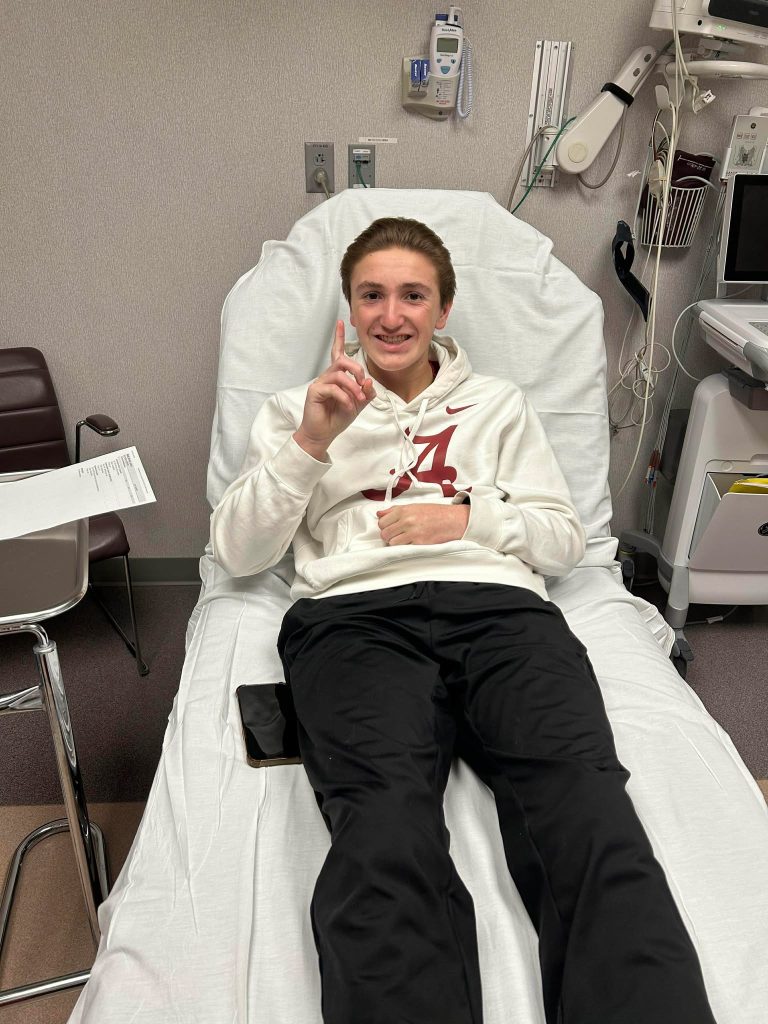
On Thanksgiving Day 2020, during the height of the pandemic, ten-year-old Brody began feeling unwell. The immediate fear was COVID-19, but a rapid test came back negative, bringing what would turn out to be a momentary wave of relief. “We truly had no idea what was coming,” his mom Jennifer recalls.
What followed, sadly, was not a simple recovery, but rather the start of a five-year journey marked by misdiagnoses, repeated hospitalizations, and uncertainty.
Brody’s story highlights the terrifying reality that many families face with rare diseases — from delayed diagnosis to evolving treatment plans and the critical need to advocate for the right care.
A ‘Normal Cold’ That Spiralled
In early December, Brody’s condition worsened rapidly. A “typical cold” had transformed into a nightmare of unbearable neck pain, headaches, nausea, and vomiting. At the ER, Brody underwent bloodwork and a lumbar puncture.
“He was terrified, and so was I,” Jennifer tells us. “I stayed with him for the blood draw, but for the spinal tap, they asked me to step out. I remember standing in the hallway, on the phone with my husband who wasn’t allowed with us due to COVID restrictions, trying to sound calm while every instinct screamed to run back into that room.”
Doctors initially treated him for bacterial meningitis, but after five days, they shifted to viral meningitis and discharged him.
Within three days however, the active, vibrant ten-year-old was “gone, replaced by a child who could barely move from the couch at home,” explains Jennifer. He stopped eating, became lethargic, and most alarmingly, lost the ability to urinate.
He was taken to the ER, then transferred to Riley Children’s Hospital in Indianapolis via ambulance. This time, no caregivers were allowed to ride with him due to the COVID restrictions.
“Thinking about him taking that ambulance ride alone still takes my breath away,” says Jennifer.
As he left, Brody told her: “Mommy, everything I see is double.”
“My heart stopped,” she recalls.
“I kept telling him we’d be right behind him. He was so brave. I walked out to our car and we drove in silence, holding hands so tightly, terrified of the unknown. I cried all the way to the hospital.”
After future testing, Brody was diagnosed with transverse myelitis. Within days, his symptoms improved, and doctors believed it was a one-time immune event. “Within 24 hours his vision improved; 72 hours he could urinate and the leg weakness and tingling eased.”
Jennifer and her husband went home with Brody on December 18th, believing and hoping the worst was behind them.
“The Most Terrifying Moment of my Life”
Sadly, the peace lasted a matter of weeks. What began as a headache at school ended with Brody disoriented, unable to find his own classroom or desk — and then a seizure in the ER.
“It was the most terrifying moment of my life. He thought I was his teacher,” says Jennifer. “I remember looking at the nurse when the seizure ended and whispering ‘what is happening to my baby?’”
He was treated with anti-seizure medication and admitted to the ICU, and placed on EEG monitoring.
“His personality changed,” Jennifer details. “He was agitated and irritable. It didn’t feel like him.”
They were eventually discharged again without clear answers.
The ‘Zebra’ Emerges
Within a week, symptoms returned — the weakness, the tingling, the inability to urinate. A fourth hospital admission in ten weeks ensued… and it was at Riley when the medical narrative shifted.
A medical student, assigned to the case “sat with us and listened… and then shared something deeply meaningful, a guiding principle taught in medical school,” Jennifer remembers.
This principle was: ‘When you hear hoofbeats, think horses—look for the common, the expected. But sometimes, it isn’t a horse at all, sometimes it’s a zebra.’
“With a softness in his voice, he told us that Brody was his zebra – his rare, unforgettable case. He said he felt honored to be part of Brody’s care, that Brody had already taught him a lesson most doctors don’t learn until much later. You could see his sincerity. Brody had left an imprint, one he said he would carry forward into every patient he treated.”
Finally, a specific test was sent to the Mayo Clinic: the MOG antibody test.
Finally, a MOGAD Diagnosis – And a ‘New Normal’
A positive test changed everything.
“Finding a name for the monster was a relief,” explains Jennifer. But as anyone with the condition understands, MOGAD clearly offers no easy roadmap — especially five years ago when it was believed to affect only one in a million people.
Brody began a cycle of steroids, anti-seizure medications, and monthly IVIG infusions. Later, a second immunosuppressant, Rituximab, was added.
On the surface, Brody was thriving: he made the Honor Roll, joined the National Junior Honor Society, and even made the tennis team. But behind the scenes, the disease remained active.
Brody suffered relapses in February 2022, December 2024, and March 2025 — each brings more hospital stays, more interventions, and more disruption to his life.
Seeking a Second Opinion And Finding the Right Care
The breaking point came in early 2025 after another relapse during spring break.
“This isn’t working,” Jennifer and her husband told each other.
Desperate for answers, Jennifer turned back to a resource she had found years earlier with The MOG Project. A phone call with Jim Broutman provided the clarity they needed: Brody required a specialist, not just a general neurologist. He suggested the Mayo Clinic in Minnesota.
The difference in care was “immediate and staggering.” Within hours they received a personal, out-of-hours, call from leading neurologist and MOGAD specialist, Dr. Eoin Flanagan, who is on The MOG Project Medical Advisory Board.
“After years of struggling, I was stunned,” Jennifer says.
In August 2025, the family travelled to Mayo. There, Dr Flanagan explained that while Rituximab is a standard treatment for many autoimmune issues, it’s largely ineffective for MOGAD. Furthermore, the practice of spacing out Brody’s IVIG infusions had likely left him vulnerable to the very relapses that were threatening his mobility.
A New Path Forward
The Mayo Clinic team offered something Brody’s previous doctors hadn’t: to begin Satralizumab, via joining the METEOROID Clinical Trial – which had been shown to dramatically reduce relapse risk.
The decision to join the trial was left to Brody. He understood the risks, including the possibility of a placebo. Fortunately, the trial entered an open-label phase, ensuring Brody would receive the actual medication.
To qualify, Brody had to do the unthinkable: stop all preventative treatments for weeks to clear his system.It was a terrifying period for a family that had never seen him go untreated without a relapse.
On December 19, 2025, Brody received his first dose – a single shot that took seconds.
“I Could Not Be Stopped or Shaken”
Today, Brody has received three doses of the trial medication. For the first time in five years, there are no side effects, no moon face from steroids, and no sign of relapse.
“After five years… we’re not fully ready to relax,” Jennifer says. “But we’re closer than we’ve ever been.”
Brody, himself, seems to take it all in his stride. Reflecting on having the disease, he states that getting behind at school, following days either sick or receiving treatment has been his greatest challenge.
But, crucially, he remains positive, and the trial is helping with that as although the family are spending a lot of time travelling to receive it he says the “positives far outweigh the negatives… and it’s essentially painless.”
“Recently, I have still found enjoyment in hanging out with my friends and seeing my other friends in school as much as possible, and I’ve just tried to live as normal a life as possible,” Brody says.
His advice to others is not to give up. “As long as you trust in yourself and your ability to get better, you will. I think that I have done a great job with living life to the absolute max as best as I can despite this disease.”
Six Lessons Learned
Looking back Jennifer blames herself — as with all parents, we all tend to blame ourselves. She reflects detailing the danger of “complacency setting in, trusting a medical system.”
Looking back, Jennifer emphasizes the importance of advocacy and specialized MOGAD care. She encourages families to:
- Choose a children’s hospital.
If possible, start with a children’s hospital. Their care is holistic, child-focused, and supportive of families. - Find a specialist.
Seek someone experienced with MOGAD, not just familiar with it. Specialists provide better care, especially for rare diseases. - Advocate at school.
Push for a 504 plan or IEP if needed. Educate staff and teach your child to self-advocate as they grow. - Understand support may fade.
As crises become routine, support may lessen. Communicate your needs and ask for help when needed. - Avoid comparisons.
Celebrate your child’s unique journey instead of comparing them to others. - Practice gratitude.
Focus on small victories and stable days. Let go of imagined futures and embrace the present.
Jennifer shares, “Parenting through illness teaches the value of ordinary moments and the strength of love, compassion, and community. You are not alone, and what you do matters.”
The MOG Project is here to help! Visit mogproject.org to explore resources, find support, and take the next step in advocating for the care your loved one deserves.
Thank you for sharing your child’s story. My son, age 21, was diagnosed with MOGAD in August 2025. He was fortunate to see an Amazing Neurologist quickly, when he lost vision in his right eye ( Optic neuritis). The endless blood work, MRIs, Lumber Puncture to a young man that had never even broken a bone in his life. Collegiate football player with his whole life changing with one diagnosis. We too were fortunate to meet Dr. Eion Flanagan and Dr. Chen at the Mayo clinic in Rochester MN. He under went steriod infusion and PLEX infusions. Regaining his eyesight, with a new normal, I should say. He started in a trial, but with the travel of 6 hours became hard for him. He is now taking Actemra and is playing football again. With continued care and monitoring through the Mayo, we hope to keep his disease at bay.
Comments are closed.