The State of MOGAD Science: What We Learned Together
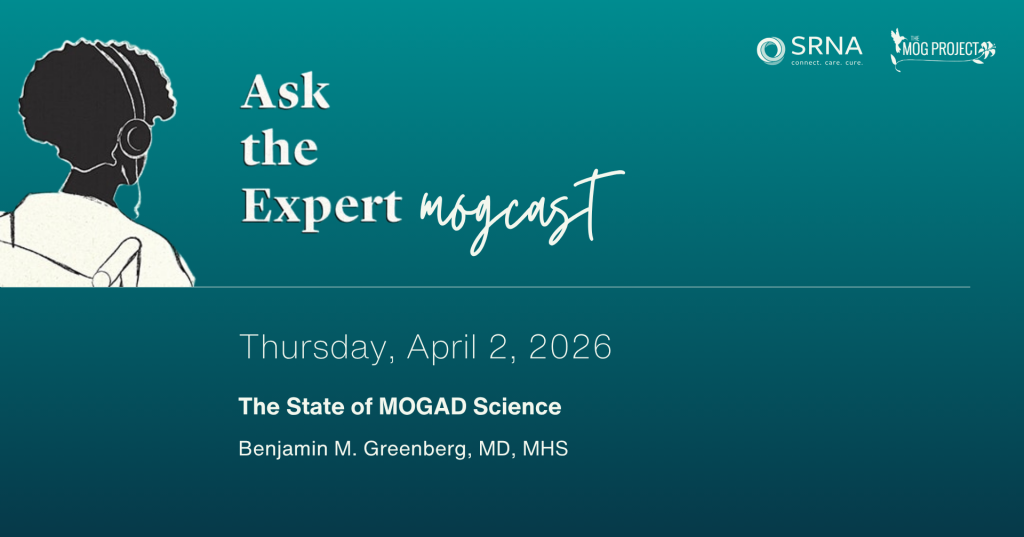
This MOGAD Awareness Month, we came together with the Siegel Rare Neuroimmune Association (SRNA) to host a special MOGcast with Dr. Benjamin Greenberg, a leading researcher in neuroimmunology from UT Southwestern. We focused on one critical question:
Where does MOGAD science stand today and where is it going next?
To explore this, Dr. Greenberg highlighted significant advancements in MOGAD research over the past three years, including standardized diagnostic criteria, basic science, and clinical trials. But it was more than just a discussion about science. It was a reminder of what we can do when we work together!
Why Awareness and Collaboration Matter
MOGAD is rare and often misunderstood. That’s why awareness matters so much! When organizations like The MOG Project and SRNA work together, it allows us to:
– Share trusted information
– Reach more people globally
– Support research and clinical trials
– Give people with rare neuroimmune disorders and families a stronger voice
As a team, SRNA and The MOG Project are capable of amazing things. SRNA shared about their collaboration with us for MOGAD Awareness month in a blog, highlighting the work that can be done when organizations come together.
This MOGCast is a great example of that teamwork in action. And as Dr. Greenberg shared during the conversation, that kind of community engagement plays a real role in moving research forward.
What’s New in MOGAD Research?
Dr. Greenberg explained that a lot has changed in just a few years. Research is moving forward in several important ways:
- Better Diagnosis
Doctors now have clearer guidelines to diagnose MOGAD. The release of standardized diagnostic criteria has increased awareness and organization of MOGAD research. This helps people with MOGAD get answers sooner and helps researchers study the disease more effectively. - Understanding Relapse Risks
Researchers are working to answer a big question: Who is most likely to have another attack?
Right now, one key clue is whether MOG antibodies stay positive over time. Dr. Greenberg explains that sustained positive antibody levels over a year significantly increase the risk for future events. But scientists are digging deeper to find better ways to identify risk factors. - New Treatment Options
There are now large clinical trials testing treatments specifically for MOGAD – and with the positive results from the Meteoroid study on saturlizumab, communities are driving drug develop and clinical trials forward. This is a crucial step forward! If these treatments are approved, it could make it easier for people with MOGAD to access care and for doctors to choose the best options. - Looking Ahead to the Future
Some of the most exciting ideas focus on “resetting” or retraining the immune system so it stops attacking the body in the first place.
This includes research on: 1) Regulating the immune system more precisely with T-regulatory cells (Tregs) and 2) Removing harmful immune cells and allowing new ones to grow. These approaches are still being studied, but they offer real hope!
The Role of the MOGAD Community
This MOGCast was packed with insightful information, but one message came through loud and clear about the future of MOGAD: Our community plays a critical role in progress when they join registries, participate in research, and complete surveys. Engaged communities can directly influence research funding, trial development, and the speed of scientific discovery.
In other words, awareness is not just about being seen. Rather, it’s ultimately about making progress possible.
A Reason For Hope
This MOGcast reflects what’s possible when people with MOGAD, researchers, and organizations collaborate. The partnership between The MOG Project and the Siegel Rare Neuroimmune Association continues to drive awareness, education, and research forward—bringing us closer to better treatments and, ultimately, a cure.
Dr. Greenberg concluded the MOGCast with a message of hope:
“This is a disease we will conquer. It’s a matter of when and how, not if.”
That doesn’t mean we’re there yet, but it does mean there is real momentum! And that momentum is driven by science, collaboration, and a strong, engaged community.
Watch the Full MOGCast
This blog only covers part of our conversation. To hear directly from Dr. Greenberg and learn more about the latest in MOGAD research, watch the full MOGCast below ⬇️
Unanswered Questions from the MOGCast
Dr. Greenberg explained that a lot has changed in just a few years. Research is moving forward in several important ways:
- Any supportive treatment (other than immune modulation) to facilitate recovery and rehabilitation — specifically for neurological involvement?
Rehab is critical today. We think exercise and nutrition can play a role as well, but the data is more sparse. - Do we know if optic neuritis or MOGAD comes first when someone is diagnosed with ADEM?
In people diagnosed with ADEM, a large number are anti-MOG positive and we think the antibody comes first. - I developed MOGAD at age 64 with bilateral ON, then relapsed 8 months later with unilateral ON while in the process of diagnosis. I’m in my 3rd year of receiving on IVIG which has kept me relapse free. I started IVIG every 2 weeks, then 4 weeks, and now 8 weeks. My neurologist mentioned maybe going to every 12 weeks in the future. Are you aware of any research on extending time between IVIG infusions?
We have very limited data on spacing out IVIG in MOGAD. We extrapolate from other conditions that suggest every 4 and 8 weeks works well, but there is far less data for every 12 weeks. This decision is made on a case by case basis. - For adults, have you ever seen an initial presentation being a fever of unknown origin (102+) with no other symptoms other than elevated inflammation markers?
I have not.
As MOGAD Awareness Month reminds us: Progress is happening, and hope is justified!