My name is Andrea Mitchell and this is my MOG Antibody DiseaseOften referred to as MOGAD, Anti-MOG, MOG Ab+, MOG Antibody Disease, MOG Associated Antibody Disease, MOG positive disease story. I am a patient ambassador for UCB and the Director of Blind Resources for The MOGA type of protein involved in cell adhesion. Present throughout myelin sheaths. Project. MOG Antibody DiseaseOften referred to as MOGAD, Anti-MOG, MOG Ab+, MOG Antibody Disease, MOG Associated Antibody Disease, MOG positive disease (MOG-ADOften referred to as MOGAD, Anti-MOG, MOG Ab+, MOG Antibody Disease, MOG Associated Antibody Disease, MOG positive disease ) is a neurological, immune-mediated disorder in which there is inflammationA process of the immune system that involves chemicals released by immune cells (i.e. white blood cells) inducing localized heat, swelling, redness, and pain to an area that occurs when tissue becomes damaged or infected from a pathogen, and usually results in the desctruction and removal of the pathogen and/or healing to the tissue. In the case of myelin oligodendrocyte glycoprotein antibody disease (MOGAD), inflammation is the result of the incorrect targeting of the myelin oligodendrocyte glycoprotein (MOG) by the immune system, resulting in damage to myelin sheaths. in the optic nerveThe cranial nerves that relay messages from your eyes to your brain to create visual images. These nerves extend from the retina in the back of the eyes to the part of the brain that processes what we see. In myelin oligodendrocyte glycoproten antibody disease (MOGAD), they may be the target of inflammation or lesions, sometimes causing visual disruption or blindness., spinal cord and/or brain. Myelin oligodendrocyte glycoprotein (MOG)A type of protein involved in cell adhesion. Present throughout myelin sheaths. is a protein that is located onInflammation of the optic nerve that may be classified as unilateral (affecting one eye) or bilateral (affecting both eyes) that may result in vision changes, vision loss, and/or pain with eye movement. the surface of myelinAn insulating layer, or sheath that forms around nerves, including those in the brain and spinal cord. It is made up of protein and fatty substances. This myelin sheath allows electrical impulses to transmit quickly and efficiently along the nerve cells. If myelin is damaged, these impulses slow down. sheaths in the central nervous systemNerve tissue that resides in and composes the brain, spinal cord, and optic nerve. I am hoping to help other people going through this condition understand the importance of getting immediate treatment when having a relapseWhen you present to your doctor or hospital with new or worsening central nervous system symptoms. Generally, if your symptoms gradually worsen over 24-48 hours, there is heightened concern of a relapse. (Also referred to as a flare by the myelin oligodendrocyte glycoproten antibody disease (MOGAD) community)..
I was 45 years old, when I had a clostridium difficile infection and amoebas after my husband and I returned from our trip to Cabo San Lucas in Mexico. I had to take antibiotics for 3 months. The C-diff infection hit me hard as I was training a new hire class in Minnesota and I remember almost passing out while I was trying to instruct the class. I had tears rolling down my face and left to go to the nearest hospital for treatment. I was given IVA way of giving a drug or other substance through a needle or tube inserted into a vein. fluids and testing to see what was going onInflammation of the optic nerve that may be classified as unilateral (affecting one eye) or bilateral (affecting both eyes) that may result in vision changes, vision loss, and/or pain with eye movement.. After the discovery of C-diff along with parasites and amoebas, I was sent home with various medications. My supervisor recommended that I return home and work out of my home office location.
I vividly recall a few days before my first MOG attack, a green light flashed across my field of vision and everything went black for about a minute. I went to lay down and did not think much of it as my vision fully returned. Looking back, I believe it was a foreshadowing on what was about to happen.
I woke up onInflammation of the optic nerve that may be classified as unilateral (affecting one eye) or bilateral (affecting both eyes) that may result in vision changes, vision loss, and/or pain with eye movement. October 1st, 2011 and I had a horrible migraine with intense eye pain and blurriness in my left eye. I do not know how but I drove to my job as an instructor for Comcast, which was 25 miles away in Livermore, California. I just thought that I was having a migraine with aura. When I sat at my desk to sign into my computer, I could not see enough to sign into it. I immediately called my medical provider and was advised that it may just be a migraine affecting my vision. They informed me to get some rest and call in the morning if it did not get better. I called my supervisor and advised her of the situation and went home for the day.
I remember feeling a little scared but had no idea what I was about to learn. That was the last day that I worked at Comcast.
I did not get better in the morning, and everything was black with total darkness in my left eye. I was then given an emergency appointment with an ophthalmologistA board-certified medical doctor that specializes in diseases and disorders of the eye. in Walnut Creek, Ca. He noticed that my optic nerveThe cranial nerves that relay messages from your eyes to your brain to create visual images. These nerves extend from the retina in the back of the eyes to the part of the brain that processes what we see. In myelin oligodendrocyte glycoproten antibody disease (MOGAD), they may be the target of inflammation or lesions, sometimes causing visual disruption or blindness. was swollen in my left eye and that was causing the blindnessAny alterations in your ability to see normally which may include blurred vision, cloudy vision, double vision, color change, seeing spots in your vision, or loss of vision. Vision changes may occur in one or both eyes. With MOGAD, vision changes are caused by optic neuritis.. I could tell by his expression that something was really wrong. He sent me to the emergency room where they admitted me into the hospital immediately. The doctor came in and explained that after running a series of tests, that my MRIA noninvasive imaging technique that uses strong magnetic fields to produce images of nearly any structure of the body. For MOGAD, it is typically used with and without contrast to identify disease activity in the central nervous system. showed enhancements in my left optic nerveThe cranial nerves that relay messages from your eyes to your brain to create visual images. These nerves extend from the retina in the back of the eyes to the part of the brain that processes what we see. In myelin oligodendrocyte glycoproten antibody disease (MOGAD), they may be the target of inflammation or lesions, sometimes causing visual disruption or blindness.. I was given IVA way of giving a drug or other substance through a needle or tube inserted into a vein. steroidsA type of medication typically given intraveneously or orally. For myelin oligodendrocyte glycoprotein antibody disease (MOGAD) it is used as an immunosuppressant and anti-inflammatory to reduce disease activity and inflammation. In adults, it is sometimes used in high doses for acute attacks. In some adult patients, it may be used for 1-2 months after an acute attack to avoid a rapid onset of relapse. Higher doses (>10mg/day) are not recommended for an extended period of time but lower doses (<=10mg/day) may be used in some patients longer term. In children, it may be used after treatment of an acute attack, but it is not recommended long-term due to the profound effects of chronic steroids on a child’s health. Use of oral prednisone as a maintenance therapy in relapsing pediatric MOGAD patients is discouraged due to side effects in developing children, and other therapies such as monthly immune globulin are suggested. (To understand relapsing during steroid tapering, see Steroid Dependency) and discharged that evening. I was given four days of liquid steroidsA type of medication typically given intraveneously or orally. For myelin oligodendrocyte glycoprotein antibody disease (MOGAD) it is used as an immunosuppressant and anti-inflammatory to reduce disease activity and inflammation. In adults, it is sometimes used in high doses for acute attacks. In some adult patients, it may be used for 1-2 months after an acute attack to avoid a rapid onset of relapse. Higher doses (>10mg/day) are not recommended for an extended period of time but lower doses (<=10mg/day) may be used in some patients longer term. In children, it may be used after treatment of an acute attack, but it is not recommended long-term due to the profound effects of chronic steroids on a child’s health. Use of oral prednisone as a maintenance therapy in relapsing pediatric MOGAD patients is discouraged due to side effects in developing children, and other therapies such as monthly immune globulin are suggested. (To understand relapsing during steroid tapering, see Steroid Dependency) and a referral to a neurologist. The steroidsA type of medication typically given intraveneously or orally. For myelin oligodendrocyte glycoprotein antibody disease (MOGAD) it is used as an immunosuppressant and anti-inflammatory to reduce disease activity and inflammation. In adults, it is sometimes used in high doses for acute attacks. In some adult patients, it may be used for 1-2 months after an acute attack to avoid a rapid onset of relapse. Higher doses (>10mg/day) are not recommended for an extended period of time but lower doses (<=10mg/day) may be used in some patients longer term. In children, it may be used after treatment of an acute attack, but it is not recommended long-term due to the profound effects of chronic steroids on a child’s health. Use of oral prednisone as a maintenance therapy in relapsing pediatric MOGAD patients is discouraged due to side effects in developing children, and other therapies such as monthly immune globulin are suggested. (To understand relapsing during steroid tapering, see Steroid Dependency) did not work and I was still blind in my left eye. The neurologist that I was referred to was genuinely concerned about what was going onInflammation of the optic nerve that may be classified as unilateral (affecting one eye) or bilateral (affecting both eyes) that may result in vision changes, vision loss, and/or pain with eye movement.. He did some more blood tests and a spinal tapA procedure that involves inserting a needle into the spinal canal to collect spinal fluid, typically for diagnostic purposes. Often used during diagnosis of neurological conditions. Otherwise known as a lumbar puncture.. He also referred me to a neuro-ophthalmologist located in Redwood City, California. The neuro-ophthalmologist did a thorough work up, 25 vials of blood tests, and everything came back normal including my spinal tapA procedure that involves inserting a needle into the spinal canal to collect spinal fluid, typically for diagnostic purposes. Often used during diagnosis of neurological conditions. Otherwise known as a lumbar puncture.. I was tested for cat scratch fever, lyme disease, sarcoidosis and HIV. It was not standard practice to do a MOGA type of protein involved in cell adhesion. Present throughout myelin sheaths. antibodyA protective protein produced by your immune system that attaches to antigens (foreign substances), such as bacteria and toxins, and removes them from your body. In myelin oligodendrocyte glycoproten antibody disease (MOGAD), the body incorrectly produces an antibody that targets myelin oligodendrocyte glycoprotein, a component of the myelin sheath in the central nervous system. test in 2011 so that was the one test that was missed. I was his first patient with MOGA type of protein involved in cell adhesion. Present throughout myelin sheaths. and today he has over a dozen of MOGA type of protein involved in cell adhesion. Present throughout myelin sheaths. patients.
He first put me onInflammation of the optic nerve that may be classified as unilateral (affecting one eye) or bilateral (affecting both eyes) that may result in vision changes, vision loss, and/or pain with eye movement. 60 milligrams of steroidsA type of medication typically given intraveneously or orally. For myelin oligodendrocyte glycoprotein antibody disease (MOGAD) it is used as an immunosuppressant and anti-inflammatory to reduce disease activity and inflammation. In adults, it is sometimes used in high doses for acute attacks. In some adult patients, it may be used for 1-2 months after an acute attack to avoid a rapid onset of relapse. Higher doses (>10mg/day) are not recommended for an extended period of time but lower doses (<=10mg/day) may be used in some patients longer term. In children, it may be used after treatment of an acute attack, but it is not recommended long-term due to the profound effects of chronic steroids on a child’s health. Use of oral prednisone as a maintenance therapy in relapsing pediatric MOGAD patients is discouraged due to side effects in developing children, and other therapies such as monthly immune globulin are suggested. (To understand relapsing during steroid tapering, see Steroid Dependency). Within 2 weeks, I woke up completely blind in both eyes. I was terrified. We tried 1,000 grams of IVA way of giving a drug or other substance through a needle or tube inserted into a vein. steroidsA type of medication typically given intraveneously or orally. For myelin oligodendrocyte glycoprotein antibody disease (MOGAD) it is used as an immunosuppressant and anti-inflammatory to reduce disease activity and inflammation. In adults, it is sometimes used in high doses for acute attacks. In some adult patients, it may be used for 1-2 months after an acute attack to avoid a rapid onset of relapse. Higher doses (>10mg/day) are not recommended for an extended period of time but lower doses (<=10mg/day) may be used in some patients longer term. In children, it may be used after treatment of an acute attack, but it is not recommended long-term due to the profound effects of chronic steroids on a child’s health. Use of oral prednisone as a maintenance therapy in relapsing pediatric MOGAD patients is discouraged due to side effects in developing children, and other therapies such as monthly immune globulin are suggested. (To understand relapsing during steroid tapering, see Steroid Dependency) for 3 days. I did not get any of my sight back. He then suggested plasma exchangeA procedure in which a machine is used to separate the patient’s plasma from the blood cells. The plasma is separated from the blood cells, the blood cells are mixed with a liquid to replace the plasma, then it is returned to the patient’s body. For myelin oligodendrocyte glycoprotein antibody disease (MOGAD), this treatment is sometimes given to remove antibodies from the blood stream to reduce disease activity during an active attack. May be used as a preventative treatment when other treatment options fail. (PLEXA procedure in which a machine is used to separate the patient’s plasma from the blood cells. The plasma is separated from the blood cells, the blood cells are mixed with a liquid to replace the plasma, then it is returned to the patient’s body. For myelin oligodendrocyte glycoprotein antibody disease (MOGAD), this treatment is sometimes given to remove antibodies from the blood stream to reduce disease activity during an active attack. May be used as a preventative treatment when other treatment options fail.). I was admitted into the hospital for two weeks and I had seven plasma exchangeA procedure in which a machine is used to separate the patient’s plasma from the blood cells. The plasma is separated from the blood cells, the blood cells are mixed with a liquid to replace the plasma, then it is returned to the patient’s body. For myelin oligodendrocyte glycoprotein antibody disease (MOGAD), this treatment is sometimes given to remove antibodies from the blood stream to reduce disease activity during an active attack. May be used as a preventative treatment when other treatment options fail. sessions with a break in between. I did get a good amount of sight back in my right eye. It was at 20/50. My left eye remained blind.
Since my relapsesWhen you present to your doctor or hospital with new or worsening central nervous system symptoms. Generally, if your symptoms gradually worsen over 24-48 hours, there is heightened concern of a relapse. (Also referred to as a flare by the myelin oligodendrocyte glycoproten antibody disease (MOGAD) community). were not under control, I lost the majority of sight in my right eye within the first two years of trying to find a diagnosis. I was relapsing every 6 months. I have had multiple life-threatening blood clots after receiving six separate plasma exchangeA procedure in which a machine is used to separate the patient’s plasma from the blood cells. The plasma is separated from the blood cells, the blood cells are mixed with a liquid to replace the plasma, then it is returned to the patient’s body. For myelin oligodendrocyte glycoprotein antibody disease (MOGAD), this treatment is sometimes given to remove antibodies from the blood stream to reduce disease activity during an active attack. May be used as a preventative treatment when other treatment options fail. treatments. I had deep vein thrombosis and pulmonary embolisms. The treatments almost cost me my life and I will only use plasma exchangeA procedure in which a machine is used to separate the patient’s plasma from the blood cells. The plasma is separated from the blood cells, the blood cells are mixed with a liquid to replace the plasma, then it is returned to the patient’s body. For myelin oligodendrocyte glycoprotein antibody disease (MOGAD), this treatment is sometimes given to remove antibodies from the blood stream to reduce disease activity during an active attack. May be used as a preventative treatment when other treatment options fail. as a last resort for future treatment options. I was onInflammation of the optic nerve that may be classified as unilateral (affecting one eye) or bilateral (affecting both eyes) that may result in vision changes, vision loss, and/or pain with eye movement. blood thinners for five years and I was taken off them as I was reevaluated, and it was determined that my blood clots may have been a result from my catheters for the plasma exchangeA procedure in which a machine is used to separate the patient’s plasma from the blood cells. The plasma is separated from the blood cells, the blood cells are mixed with a liquid to replace the plasma, then it is returned to the patient’s body. For myelin oligodendrocyte glycoprotein antibody disease (MOGAD), this treatment is sometimes given to remove antibodies from the blood stream to reduce disease activity during an active attack. May be used as a preventative treatment when other treatment options fail. treatments.

I was determined to find answers. How could I be legally blind without any explanation? Over the last ten years, I have seen doctors at Kaiser, Stanford, Mayo Clinic and UCSF. I currently have a consulting doctor who is an expert in the field, from Massachusetts General Hospital. The best suggestion that I received was from my doctor at UCSF to get the MOGA type of protein involved in cell adhesion. Present throughout myelin sheaths. antibodyA protective protein produced by your immune system that attaches to antigens (foreign substances), such as bacteria and toxins, and removes them from your body. In myelin oligodendrocyte glycoproten antibody disease (MOGAD), the body incorrectly produces an antibody that targets myelin oligodendrocyte glycoprotein, a component of the myelin sheath in the central nervous system. test in 2013.
My doctor had to fight to get that test, but he was finally able to send my blood sample to Oxford, UK. I finally received some answers. My test came back positive. Before getting the correct diagnosis, I was told that I had CRION, which is Chronic Relapsing Inflammatory Optic Neuritis.
I was onInflammation of the optic nerve that may be classified as unilateral (affecting one eye) or bilateral (affecting both eyes) that may result in vision changes, vision loss, and/or pain with eye movement. 60 to 90 milligrams of steroidsA type of medication typically given intraveneously or orally. For myelin oligodendrocyte glycoprotein antibody disease (MOGAD) it is used as an immunosuppressant and anti-inflammatory to reduce disease activity and inflammation. In adults, it is sometimes used in high doses for acute attacks. In some adult patients, it may be used for 1-2 months after an acute attack to avoid a rapid onset of relapse. Higher doses (>10mg/day) are not recommended for an extended period of time but lower doses (<=10mg/day) may be used in some patients longer term. In children, it may be used after treatment of an acute attack, but it is not recommended long-term due to the profound effects of chronic steroids on a child’s health. Use of oral prednisone as a maintenance therapy in relapsing pediatric MOGAD patients is discouraged due to side effects in developing children, and other therapies such as monthly immune globulin are suggested. (To understand relapsing during steroid tapering, see Steroid Dependency) for 5 years straight and gained 100 Lbs. I was even informed by a doctor that steroidsA type of medication typically given intraveneously or orally. For myelin oligodendrocyte glycoprotein antibody disease (MOGAD) it is used as an immunosuppressant and anti-inflammatory to reduce disease activity and inflammation. In adults, it is sometimes used in high doses for acute attacks. In some adult patients, it may be used for 1-2 months after an acute attack to avoid a rapid onset of relapse. Higher doses (>10mg/day) are not recommended for an extended period of time but lower doses (<=10mg/day) may be used in some patients longer term. In children, it may be used after treatment of an acute attack, but it is not recommended long-term due to the profound effects of chronic steroids on a child’s health. Use of oral prednisone as a maintenance therapy in relapsing pediatric MOGAD patients is discouraged due to side effects in developing children, and other therapies such as monthly immune globulin are suggested. (To understand relapsing during steroid tapering, see Steroid Dependency) do not have calories. I went into menopause the first year of taking steroidsA type of medication typically given intraveneously or orally. For myelin oligodendrocyte glycoprotein antibody disease (MOGAD) it is used as an immunosuppressant and anti-inflammatory to reduce disease activity and inflammation. In adults, it is sometimes used in high doses for acute attacks. In some adult patients, it may be used for 1-2 months after an acute attack to avoid a rapid onset of relapse. Higher doses (>10mg/day) are not recommended for an extended period of time but lower doses (<=10mg/day) may be used in some patients longer term. In children, it may be used after treatment of an acute attack, but it is not recommended long-term due to the profound effects of chronic steroids on a child’s health. Use of oral prednisone as a maintenance therapy in relapsing pediatric MOGAD patients is discouraged due to side effects in developing children, and other therapies such as monthly immune globulin are suggested. (To understand relapsing during steroid tapering, see Steroid Dependency). It took two years for my diagnosis and that time might have cost me my sight. I was often hearing things like, “Let’s wait and see what happens.” Some doctors insisted that having MOG Antibody-Associated DiseaseOften referred to as MOGAD, Anti-MOG, MOG Ab+, MOG Antibody Disease, MOG Associated Antibody Disease, MOG positive disease was not as devastating as Aquaporin-4 positive NMO, and that the recovery was much better. I begged to differ, as I became legally blind in both of my eyes. I had a dozen optic neuritisInflammation of the optic nerve that may be classified as unilateral (affecting one eye) or bilateral (affecting both eyes) that may result in vision changes, vision loss, and/or pain with eye movement. relapsesWhen you present to your doctor or hospital with new or worsening central nervous system symptoms. Generally, if your symptoms gradually worsen over 24-48 hours, there is heightened concern of a relapse. (Also referred to as a flare by the myelin oligodendrocyte glycoproten antibody disease (MOGAD) community).. I had to be my own advocate and insist onInflammation of the optic nerve that may be classified as unilateral (affecting one eye) or bilateral (affecting both eyes) that may result in vision changes, vision loss, and/or pain with eye movement. seeing other doctors in order to find one that understands this condition.
I tried intravenousA way of giving a drug or other substance through a needle or tube inserted into a vein. immunoglobulinA human blood donor product made up of immunoglobulins (IgG and IgM antibodies) derived from plasma that can be administered intravenously (IVIG) or subcutaneously (SCIG). For myelin oligodendrocyte glycoprotein antibody disease (MOGAD), it is used as an immunomodulator to reduce disease activity. Sometimes used for acute attacks or as an ongoing preventative treatment. (IVIG) as a preventative medication but had to stop as I was getting extremely sick. I had horrible migraines, nausea and vomiting from it. I had aseptic meningitisInflammation of the brain and spinal cord membranes. In myelin oligodendrocyte glycoproten antibody disease (MOGAD), may be a serious drug-induced side effect caused by intravenous immunoglobulin (IVIG) treatment. a few times and found out that I was getting too much and was not being dosed by my ideal body weight. That caused me to have extremely high blood pressure and a fast heart rate. I then switched to a common rheumatoid arthritis medication and stayed stable for 3 years. However, I woke up with noticeable hearing loss in 2016. This was confirmed by an ENT doctor along with my neurologist to be relapse-related by blood work and MRIA noninvasive imaging technique that uses strong magnetic fields to produce images of nearly any structure of the body. For MOGAD, it is typically used with and without contrast to identify disease activity in the central nervous system. of the inner ear canal. Thankfully, after a taper of steroidsA type of medication typically given intraveneously or orally. For myelin oligodendrocyte glycoprotein antibody disease (MOGAD) it is used as an immunosuppressant and anti-inflammatory to reduce disease activity and inflammation. In adults, it is sometimes used in high doses for acute attacks. In some adult patients, it may be used for 1-2 months after an acute attack to avoid a rapid onset of relapse. Higher doses (>10mg/day) are not recommended for an extended period of time but lower doses (<=10mg/day) may be used in some patients longer term. In children, it may be used after treatment of an acute attack, but it is not recommended long-term due to the profound effects of chronic steroids on a child’s health. Use of oral prednisone as a maintenance therapy in relapsing pediatric MOGAD patients is discouraged due to side effects in developing children, and other therapies such as monthly immune globulin are suggested. (To understand relapsing during steroid tapering, see Steroid Dependency), I was able to get most of my hearing back. Unfortunately, a relapseWhen you present to your doctor or hospital with new or worsening central nervous system symptoms. Generally, if your symptoms gradually worsen over 24-48 hours, there is heightened concern of a relapse. (Also referred to as a flare by the myelin oligodendrocyte glycoproten antibody disease (MOGAD) community). struck again the following year. I was quick in getting a hearing test along with a MRI of the inner ear canal to confirm what was going onInflammation of the optic nerve that may be classified as unilateral (affecting one eye) or bilateral (affecting both eyes) that may result in vision changes, vision loss, and/or pain with eye movement.. I regained most of my hearing back from a taper of steroidsA type of medication typically given intraveneously or orally. For myelin oligodendrocyte glycoprotein antibody disease (MOGAD) it is used as an immunosuppressant and anti-inflammatory to reduce disease activity and inflammation. In adults, it is sometimes used in high doses for acute attacks. In some adult patients, it may be used for 1-2 months after an acute attack to avoid a rapid onset of relapse. Higher doses (>10mg/day) are not recommended for an extended period of time but lower doses (<=10mg/day) may be used in some patients longer term. In children, it may be used after treatment of an acute attack, but it is not recommended long-term due to the profound effects of chronic steroids on a child’s health. Use of oral prednisone as a maintenance therapy in relapsing pediatric MOGAD patients is discouraged due to side effects in developing children, and other therapies such as monthly immune globulin are suggested. (To understand relapsing during steroid tapering, see Steroid Dependency) but have some residual hearing loss from both relapsesWhen you present to your doctor or hospital with new or worsening central nervous system symptoms. Generally, if your symptoms gradually worsen over 24-48 hours, there is heightened concern of a relapse. (Also referred to as a flare by the myelin oligodendrocyte glycoproten antibody disease (MOGAD) community)..
It was discovered that I have a neurogenic bladder by a urologist as I have sudden urges, frequency, retention and have to get into certain positions in order to empty my bladder. I have unexplained electrical shocks randomly all over my body, pain throughout my body and what I refer to as “MOGA type of protein involved in cell adhesion. Present throughout myelin sheaths. fog”. It is like something affecting my concentration and memory. I just cannot think clearly. It is sometimes disabling. Especially when trying to learn new things.
I often wonder if I might not be legally blind today if the MOG antibody test had existed, when I had my first attack or if my doctors treated my relapses aggressively enough or if doctors were aware of the MOG antibody disease back in 2011.
I have thankfully been relapse free for almost 3 years now as I am onInflammation of the optic nerve that may be classified as unilateral (affecting one eye) or bilateral (affecting both eyes) that may result in vision changes, vision loss, and/or pain with eye movement. immune suppression medication. I give myself subcutaneousA method of administering medication by injection under the skin. injections every week. It can be challenging being immune suppressed, but I try to enjoy myself as much as possible with safety measures in place. I have also lost 60 lbs.
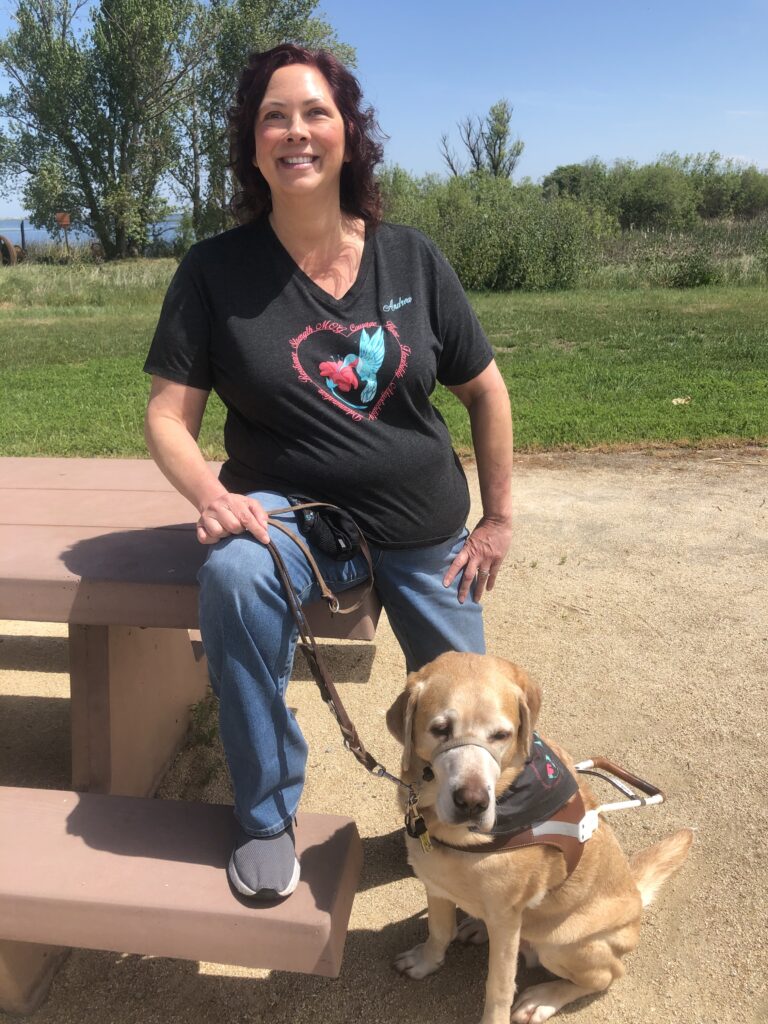
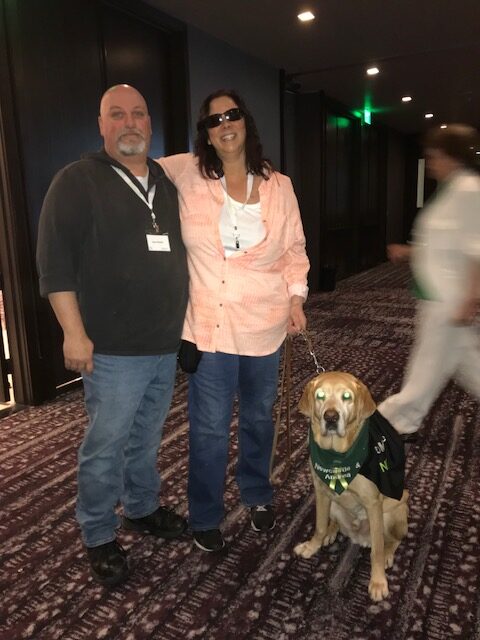
I attended a blind school in Albany California and received a beautiful guide dog from Guide Dogs for the Blind in San Rafael, California. His name is Indy and he is a gorgeous yellow lab with caramel tones in his ears and tail. He also has a white pattern along his shoulders which I refer to as his angel wings. I received him On October 1, 2021 and he does outstanding guide work. He was raised in San Jose, California. We have a loving retired guide dog named Newcastle. He is also a yellow lab and now goes to work with my husband James. Thankfully, James works from home remotely. Newcastle has guided me for seven amazing years. We have a 14-year-old Pekingese named Bubba and he rules the house. All of this has helped me remain independent. I had to learn how to walk, cook, use adaptive technology, acquire daily living skills and use a computer. Being blind is not easy but you can adapt with the right training. I have a wonderful and supportive husband who has remained by my side from the beginning. I went blind after 2 years of being married and we went through household adjustments as I could no longer work. I was the bread winner in the household before becoming blind. We lived in Discovery Bay, California and relocated to Oakley, California. I was told by somebody at the blind school that 75% of couples break up after someone goes blind. I am extremely fortunate to have such a loving and caring husband. We enjoy music, traveling and walking along the beach. He is my rock. We go to the Guthy-Jackson Charitable Foundation medical conferences every year in hopes of finding new discoveries.
I am so blessed to work with an amazing group of people at The MOG Project. I am an executive board member and Director of Blind Resources. I joined the group so that I could help others with their MOG Antibody-Associated DiseaseOften referred to as MOGAD, Anti-MOG, MOG Ab+, MOG Antibody Disease, MOG Associated Antibody Disease, MOG positive disease diagnosis. My hopes are to inform, educate, promote advocacy, support and provide awareness of all of the resources that are available. I look forward to helping as many people as I can.
The best advice that I can offer is to never stop searching for answers, even when you feel like it is going nowhere. Keep yourself up to speed on the information that is available. If you have optic neuritis, transverse myelitis, or any other related symptom, do not be afraid to ask for the MOG antibody test to be included with the other tests. It may save you from having severe disability. Remember that time is of the essence.
By Andrea Mitchell, Director of Blind Resources

Thank you for sharing your story. This is all new to me!
I just received my results on Wednesday.
I was positive for MOG. I am in research/educate-mode! I have another MRI on Sunday 10/04 and we are making a treatment plan.
Again, thank you for sharing.
Comments are closed.